“Look with all your eyes, look!” Jules Verne, Michel Strogoff
I want to share with my students my love of play, of taking a step back, and of experimentation. I want to help them sharpen their observational skills, question the ordinary, explore for the sheer joy of it, learn and relearn, and turn constraints into opportunities. I want to help them develop their ability to anticipate and imagine, but also their ability to let go.
Barbara Mélois leads workshops for people of all ages (read more)
She has presented workshops at the Today Art Museum in Beijing for adults and children as part of a tour organized by the Alliance Française network in China; at ESNAM (National School of Puppetry Arts) for teachers and students of the 13th graduating class; at the Théâtre Le Passage in Fécamp; at the Djaram’Arts Cultural Center in Senegal with underprivileged youth, as well as in numerous elementary and secondary schools.
Circus and paper characters
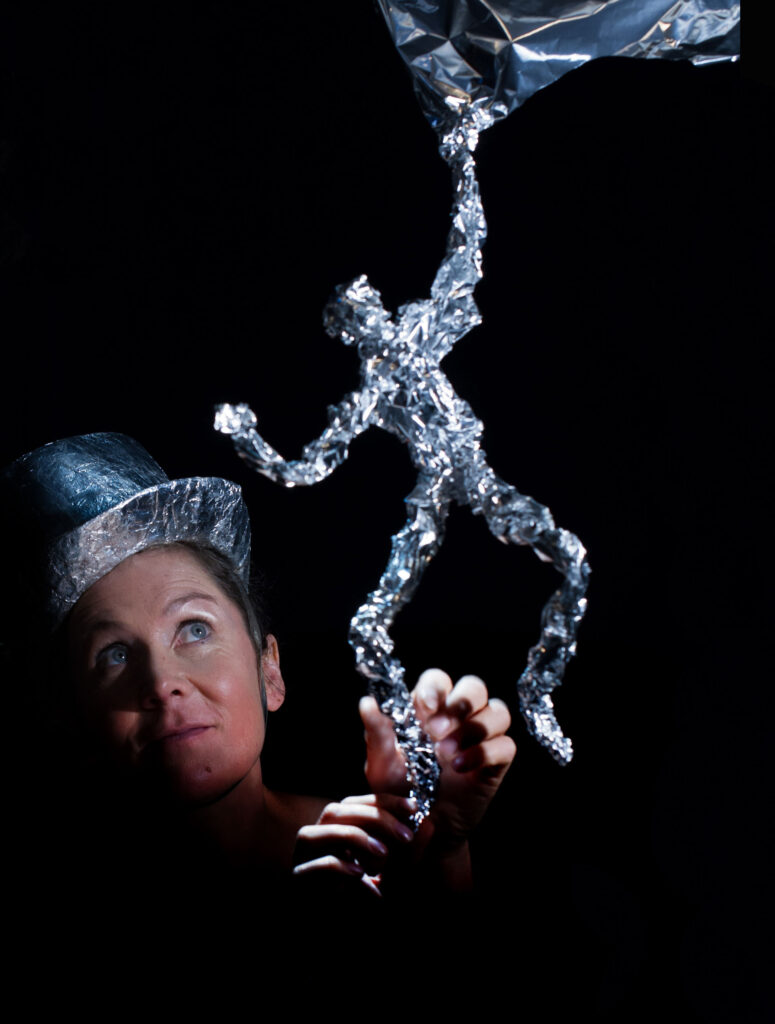
Workshop on artistic practices around puppetry
Experimenting with a Material: Aluminum Foil
A Theme: The Circus
Workshop Overview: The workshop will begin with music and a presentation of a “short piece” from my show Aluminures, in which I create aluminum foil figures on the spot. Playing on the circus theme, participants will then be guided to manipulate the provided material and experiment with shapes, with the goal of presenting the results of their experiments at the end of the workshop. Technical details:
Workshop for all audiences | Duration: 2 hours | Number of participants: 20 people maximum | Materials needed: A few tables for working in small groups of up to 6 people, 1 sound system, 1 roll of aluminum foil per group
Meeting with a puppeteer
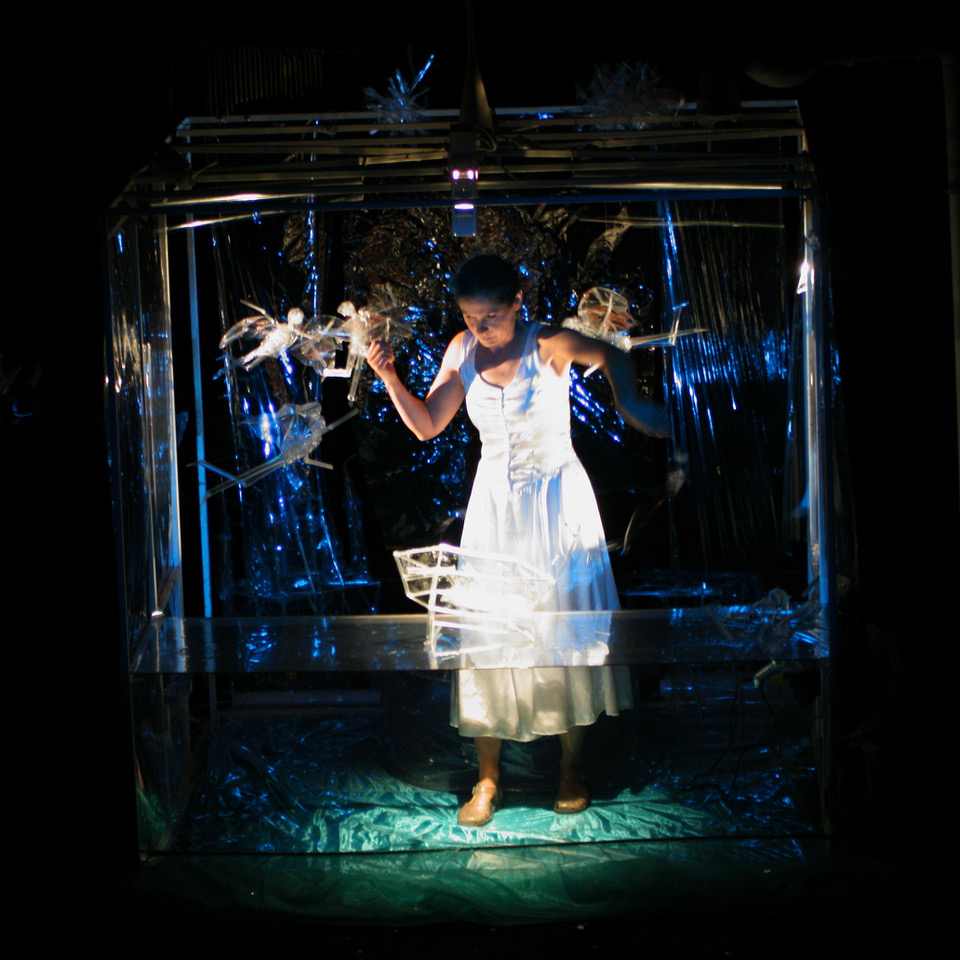
Barbara Mélois provides an overview of puppet theater in France and discusses her career path: from the École Nationale Supérieure des Arts de la Marionnette to the Festival Mondial des Marionnettes. She presents her personal work accompanied by video projections and engages with the audience.
Excerpt from “Diaphanie ou les mémoires d’une fée,” in which she utilizes the properties of cellophane. Live creation of characters and metamorphosis (transformation of the pumpkin into a carriage). In “DIAPHANIE ou les mémoires d’une fée,” the transparency of the cellophane draws us into the wondrous world of fairy tales. The crystal castle, the glass slipper, and the diaphanous gowns come to life effortlessly, and a mere snap of the fingers is enough for the spotlights to cast heat and cold, water and fire upon them. In perfect harmony with the setting of light and water she has created, Barbara Mélois delightfully reimagines the story of Cinderella. Charles Perrault had made it a universal story; she turns it into a “paradisiacal cinema” by playing with the contrasts between poetry and modernity.
Short form, creating characters and paper figures on the spot, drawn from “Aluminures,” a performance in which she makes use of the properties of aluminum foil. In “Aluminures”—a show that is both absurd and flashy—the aluminum foil roll from your kitchen unrolls and rises like a baroque barrel organ, becoming a theater, a stage curtain, a fleeting actor, sparkling with the thousand lights of a festival, dancing, singing, and offering itself as a mirror to seduce you.
“Is This a Life?”, a short piece inspired by an 18th-century fairground sales pitch and a short story by Franz Kafka, in which she uses the properties of adhesive tape. “Is This a Life?” It is mine, halfway between visual art and theater. Fifteen minutes in the life of a tightrope dancer whose Ariadne’s thread is a roll of tape. Just three small tricks, yet ones she can repeat, ones she can relive in one place, in other places, a hundred leagues from the theater, here, there. .. “A tightrope dancer, driven first by the ambition to perfect her craft, then by a habit that had become tyrannical, had organized her life in such a way that she could remain on her rope night and day for as long as she worked at the same establishment.”
For all ages, duration: 1 hour
Take one, take two, take three!
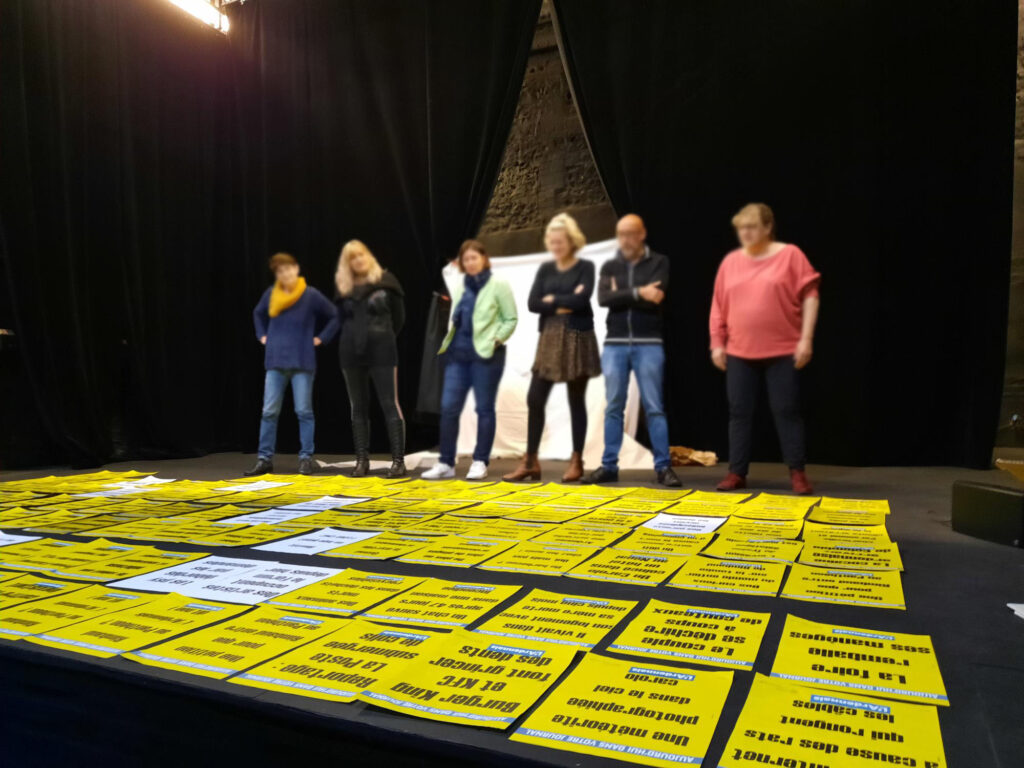
The theater’s “three knocks” resonate around a vast collection of headline posters from a provincial newspaper.
Funny, quirky, shocking, sensational, or surprising front pages become the basis for play, using materials, objects, and shadow puppetry as mediums.
A presentation time—sharing a work-in-progress rather than a full performance.
Each group chooses its front page, brings it to life, varying the intentions and register of the performance.
In groups, create a short shadow puppet sequence: making silhouettes or set elements, experimenting, using objects or materials, working on the precision of movement, storytelling, listening, verbal and non-verbal communication, sound accompaniment, the playful aspect of the exploration, and letting go.
Experimentation and back-and-forth between the workshop and the stage.
Scenographic model Brought to Life
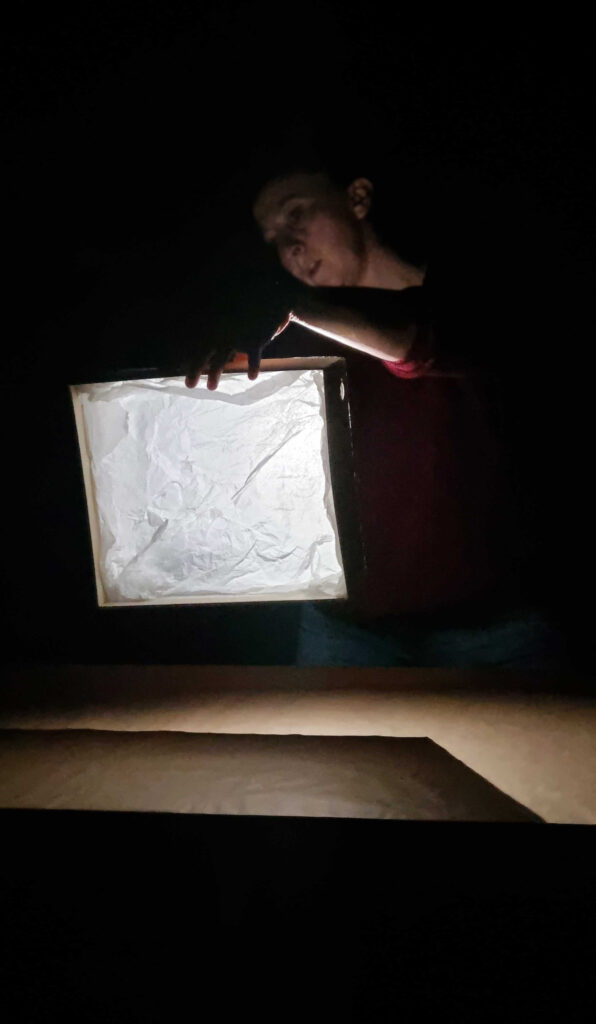
Model – in french “maquette” from the Italian macchietta, “sketch,” a diminutive derivative of macchia, from the Latin macula, “stain.”
Before the workshop, each participant will choose a short text: a poem, an excerpt from an adult or young adult novel, a song chorus, a back cover blurb, etc.
- Work will be done on the text to identify its essence and key elements.
- A model will be constructed from a simple shoebox: using collage, drawing, and cutting techniques. The model is not intended to be illustrative; it will serve as a prop for performance. When illuminated and narrated, it becomes a projection of the spirit, a vehicle for emotion.
“Representing space as sensation, as volume, as an organization of presence, and not as an image” – Daniel Jeanneteau (director and set designer)
- Work will focus on refinement and simplicity. The idea of ”sketch” is present in the etymology of the word.
- Research on sound design and sound effects.
- Gesture and speech: which comes first?
- Evocation through light.
- Experimentation and back-and-forth between the workshop and the stage.Feedback time – sharing a work-in-progress stage rather than a performance.